
Mazda CX-5 Service & Repair Manual: Oil Pressure Inspection
WARNING:
-
Hot engines and engine oil can cause severe burns. Turn off the engine and wait until it and the engine oil have cooled.
-
A vehicle that is lifted but not securely supported on safety stands is dangerous. It can slip or fall, causing death or serious injury. Never work around or under a lifted vehicle if it is not securely supported on safety stands.
-
Continuous exposure to USED engine oil has caused skin cancer in laboratory mice. Protect your skin by washing with soap and water immediately after working with engine oil.
1. Disconnect the negative battery cable..
2. Remove the front under cover No.2..
3. Remove the oil pressure switch..
NOTE:
-
Use the following SSTs in this inspection.
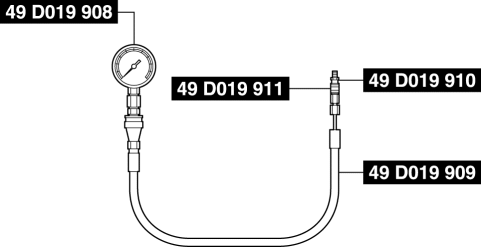
-
49 D019 908 (gauge)
-
49 D019 909 (hose)
-
49 D019 910 (adapter)
-
49 D019 911 (adapter)
4. Install the SSTs
to the oil pressure switch installation hole using the following procedure.
a. Assemble SSTs 49 D019 908
, 49 D019 909
, and 49 D019 911
outside of the engine compartment beforehand.
b. Install SST 49 D019 910
to the oil pressure switch installation hole.
c. Install SST 49 D019 911
to the SST 49 D019 910
.
5. Connect the negative battery cable..
6. Warm up the engine to normal operating temperature.
7. Run the engine at the specified speed, and note the gauge readings.
-
If not within the specification, inspect for the cause and repair or replace if necessary.
NOTE:
-
The oil pressure can vary with oil viscosity, temperature and engine speed.
-
Oil pressure (reference value) [coolant temperature: 80—90 °C {176—194 °F}]
-
Lo : 110—175 kPa {1.13—1.78 kgf/cm2, 16.0—25.3 psi} [1,500 rpm]
-
Hi : 300—430 kPa {3.06—4.38 kgf/cm2, 43.6—62.3 psi} [4,500 rpm]
8. Stop the engine and wait until it is cools.
9. Disconnect the negative battery cable..
10. Remove the SSTs.
11. Install the oil pressure switch..
12. Connect the negative battery cable..
13. Start the engine and confirm that there is no oil leakage.
-
If there is oil leakage, repair or replace the applicable part.
14. Install the front under cover No.2..
 Oil Pan
Purpose, Function
The engine oil required for lubrication in the engine accumulates in the
oil pan.
Construction
The oil pan is installed on the lower part of the cylinder block ...
 Oil Pump Removal/Installation
WARNING:
Hot engines and engine oil can cause severe burns. Turn off the engine and
wait until it and the engine oil have cooled.
A vehicle that is lifted but not securely supported ...
Other materials:
PCM Configuration (Using Read/Write Function)
NOTE:
When performing configuration, it is necessary to read the vehicle specification
information from the PCM before replacing it. Connect the M-MDS to the vehicle
and perform vehicle identification before removing the PCM. The vehicle specification
information is temporarily stor ...
A/C Unit Disassembly/Assembly
1. Disassemble in the order indicated in the table.
CAUTION:
If a non-specified grease is used, it may result in abnormal noise or improper
operation of the links. Apply only the specified grease to each link.
2. Assemble in the reverse order of disassembly.
...
Cooling System Service Warnings
WARNING:
Never remove the cooling system cap or loosen the radiator drain plug while
the engine is running, or when the engine and radiator are hot. Scalding engine
coolant and steam may shoot out and cause serious injury. It may also damage
the engine and cooling system.
Tu ...
