
Mazda CX-5 Service & Repair Manual: After Service Precaution
WARNING:
-
Fuel line spills and leakage are dangerous. Fuel can ignite and cause serious injuries or death and damage. When installing the fuel hose, perform “Fuel Leakage Inspection” described below.
-
A person charged with static electricity could cause a fire or explosion, resulting in death or serious injury. Before performing work on the fuel system, discharge static electricity by touching the vehicle body.
Fuel Leakage Inspection
Using M-MDS
1. Connect the M-MDS to the DLC-2.
2. Switch the ignition to ON (engine off).
3. Using the simulation function “FP”, start the fuel pump..
4. Verify that there is no fuel leakage from the pressurized parts.
-
Standard
-
There shall be no leakage after 5 min.
5. In the case of fuel leakage, replace the following components and then recheck using the fuel leakage checking procedure.
-
If there is leakage, replace the fuel hoses and clips.
-
If there is damage on the seal on the fuel pipe side, replace the fuel pipe.
Without using M-MDS
1. Disconnect the negative battery cable..
2. Remove the fuel pump relay.
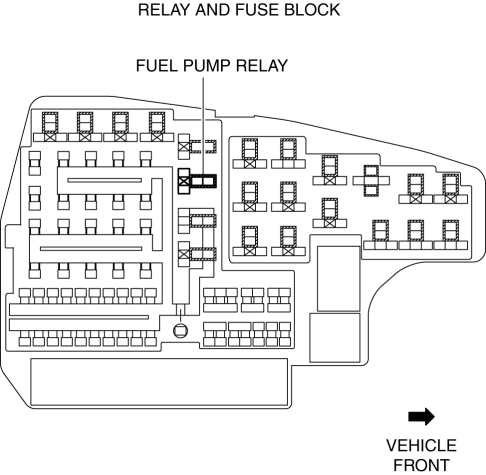
CAUTION:
-
Short the specified terminals because shorting the wrong terminal of the relay and fuse block may cause malfunctions.
3. Using a jumper wire, short fuel pump relay terminals C and D in the relay and fuse block.
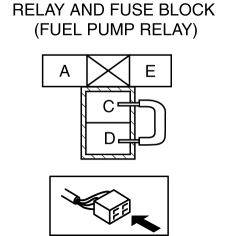
4. Connect the negative battery cable and operate the fuel pump..
5. Verify that there is no fuel leakage from the pressurized parts.
-
Standard
-
There shall be no leakage after 5 min.
6. In the case of fuel leakage, replace the following components and then recheck using the fuel leakage checking procedure.
-
If there is leakage, replace the fuel hoses and clips.
-
If there is damage on the seal on the fuel pipe side, replace the fuel pipe.
 Fuel
Fuel
...
 Before Service Precaution
WARNING:
Fuel vapor is hazardous. It can very easily ignite, causing serious injury
and damage. Always keep sparks and flames away from fuel.
Fuel line spills and leakage from the p ...
Other materials:
Liftgate Light Removal/Installation
NOTE:
Fogging or condensation on the inside of the liftgate light may occur, however,
it is a natural phenomenon occurring as a result of a temperature difference
between the interior and exterior of the liftgate lights and has no effect on
the light performance. Fogging or condensa ...
Troubleshooting
Bluetooth® does not operate under the following conditions. Check whether the
following conditions apply to your Bluetooth® device:
• The device is not being operated correctly.
• The device is not connected to the Bluetooth®
unit equipped on the vehicle.
• The device's battery i ...
Seat Belt
Outline (Standard Deployment Control System)
Three-point front seat belts with the following functions for front seat
passengers adopted.
ELR (Emergency Locking Retractor: emergency locking mechanism)
Load limiter
Pre-tensioner seat belt.
T ...
